
A farmer’s smile at a family nursery in Kotalipara
Kotalipara (Gopalganj) Correspondent:
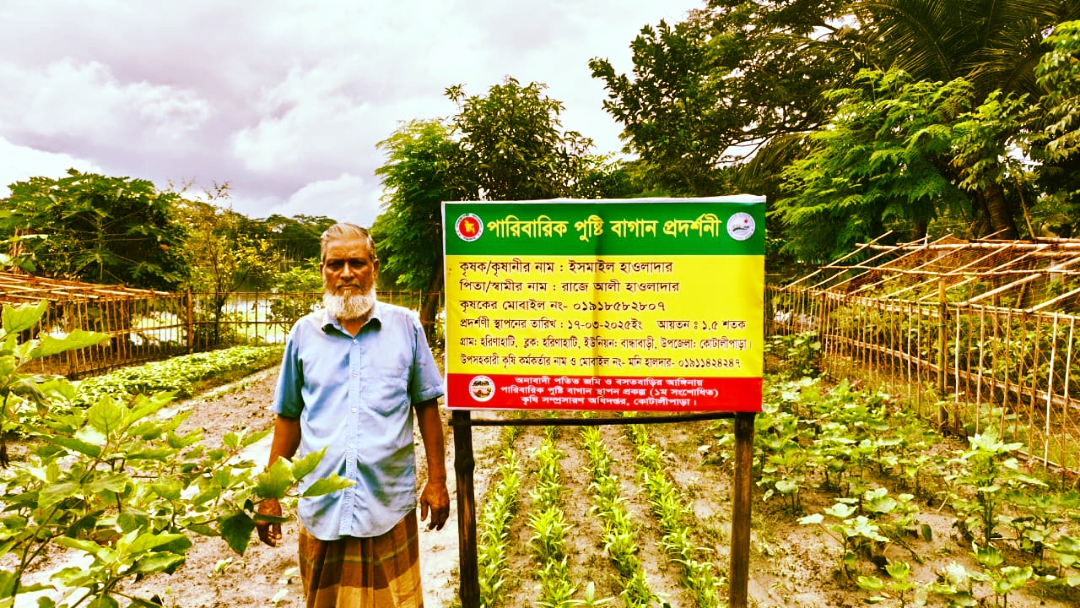
In the rural township of Kotalipara, a family nutrition garden has brought smiles to the faces of farmers. A green feast of vegetables is sprouting in unused courtyards and wastelands. This small-scale cultivation, known as the 'family nutrition garden', has become a safe source of nutrition and income for many farmers. By collecting fresh vegetables from the garden throughout the year, families are on the one hand ensuring their own nutritious food, and on the other hand, they are getting additional income by selling the surplus crops.
An average of 550 kg of vegetables is produced annually from a nutrition garden on one and a half percent of the land. Assuming the market price of 30 taka per kg, the value of these crops stands at about 16,500 taka. Since the production cost is only 3,500 taka, the farmers are getting a profit of about 13,000 taka per year. Not only that, the vegetables in these gardens are fulfilling a large part of the family's food every day. Some families say that 50 to 60 percent of their daily vegetable requirement comes from these gardens.
Ismail Hawlader, a farmer from Harinahati village in Bandhabari union, said, "I have been growing this garden for six years with the help of the agricultural office. I grow vegetables all year round. I eat them myself and sell the extra vegetables. I earn an additional income of 5-6 thousand taka a year. I would not have understood how many different crops can be grown even on a small piece of land without doing this."
Farmer Milan Sheikh of Mandra Chourkhuli village of Kushla Union said, "Family nutrition gardens are basically part of good agricultural practices. We do not use chemical fertilizers here at all. We use cow dung, leaf compost and organic fertilizers. We use various types of organic pesticides and traps to control insects. Therefore, the vegetables in this garden are not only delicious to eat, but also safe for health. The field staff of the Agriculture Department regularly inquire about our garden. They give necessary advice.
Farmer Masud Daria of Majhbari village of Hiron Union said, "The vegetables produced in my garden are completely poison-free. Therefore, there is a high demand for them in the market. I can sell them at a slightly higher price than other vegetables.
Not only does it provide economic benefits or nutritional benefits, but the family nutrition gardens have brought visible positive changes in the lives of farmers in Kotalipara. Families are now leaning towards healthy food, market dependence is decreasing, and confidence in the safe food they produce is increasing."
According to information received in the upazila, these nutrition gardens only provide financial support to the farming families. No, but it is also playing an important role in ensuring food security in the long term. Agriculture officials expect that in the next few years, almost every farming family will set up their own nutrition garden, which will increase vegetable production at the local level and further energize the rural economy.
The story of the families of Kotalipara is part of the development picture today—where a gathering of greenery on a small piece of land has become a source of nutritional security, a source of healthy food, and a source of additional income.
Upazila Agricultural Extension Officer Mukta Mandal said that the main objective of the family nutrition garden is to ensure the supply of fresh, safe, and nutritious vegetables twelve months a year. It fulfills the deficiency of vitamins and minerals required by family members. In addition, these vegetables are healthy and safe as they are cultivated without chemical fertilizers and pesticides.
He also said, “This cultivation is environmentally friendly. Following organic methods reduces environmental pollution, increases soil fertility, and makes the farmer’s production system more sustainable.
Kotalipara Upazila Agricultural Officer Dolon Chandra Roy said that the goal of the family nutrition garden is not only to produce vegetables; This is actually a sustainable agricultural management. Here, the farming families get nutritious food themselves, and at the same time, a way is created to become economically self-sufficient. He said that in the current financial year, a total of 371 nutritional gardens have been established in 16 unions and one municipal area of the upazila. Farmers have been given 13 types of vegetable seeds, organic fertilizers and necessary materials. Training and round-the-clock advice have been provided so that farmers can manage the gardens efficiently.
This project has been successfully implemented in Kotalipara for the last 6 years. Agriculture officer Dolan said that earlier many families used to leave their yard land. Now that land is their source of nutrition and money. Around 13 vegetables including red cabbage, data cabbage, jute cabbage, puishak, barbati, cucumber, gourd, sweet pumpkin, rice pumpkin, bitter gourd, lentil, tomato are being produced here throughout the year. Therefore, the family nutritional garden is now not just a project, but a real model for changing the quality of life of the people of the village.
Copyright @ 2025 EN-JUGANTOR PRATIDIN
 প্রিন্ট করুন
 সেভ করুন