
M. S. I Sharif, Bholahat (Chapainawabganj) Correspondent
The Bholahat Zonal Office of the Silk Development Board in Chapainawabganj is like a den of corruption! Although the government has taken several steps to revive the declining silk farming, the intended goal has been thwarted by irregularities, nepotism and corruption. Due to irregularities, evasion and division in the construction of silk farms, planting mulberry seedlings, providing training and distributing other materials to silk farmers with government grants, the government has only wasted money and has not touched development. In addition, the real silk farmers have complained that “sericulture” has reached the verge of being wiped out in the quicksand of so-called development.
Sources said that in order to develop sericulture and sustain its agricultural industry, the government has taken up a project to provide sericulture “basnis” with a grant of 25,000 taka for planting mulberry seedlings (mulberry seedlings) on one bigha of land, 1 lakh taka for building a silkworm house, and 60,000 taka worth of silkworm farming equipment (dala, chandraki, gharashula) and 32 nets. In addition, each basnis is given an allowance of 13,000 taka for 26 days of training. Along with this, silkworm eggs are distributed among them free of charge. Everything is provided by the government, only the silkworm farmers or basnis provide the labor.
Basnis Tofazzal Hossain of Dharampur village of Sadar Union of the upazila said that if those who do not have their own land take a lease of 1 bigha of land from others for at least 10 years, each basnis will receive a grant of 25,000 taka for planting mulberry seedlings and 1 lakh taka for building a silkworm house. In addition, they will receive around 60 thousand taka worth of poles, canes, nets and 32 nets; and they will receive 13 thousand taka for training in 26 days. But a fake deed of 1 bigha of land was made with a non-judicial stamp of 300 taka and in collusion, 25 thousand taka was taken from the government treasury for land preparation and 1 lakh taka for construction of a palughar and divided into parts. And the constructed house was built in an unplanned and weak manner.
Even Sayeed, son of Asiruddin of Dharampur village, was allocated 1 lakh taka and divided into parts by showing him an old palughar. Based Ali of Imamnagar village said that he was given 70 thousand taka for building a house and the office took 30 thousand taka. Currently, he has killed the mulberry from the land. Sajeed Ali of the same village does not cultivate palughar. However, Monirul Islam, a temporary employee of the Bholahat Zonal Office, has provided this person (Monirul’s father-in-law) with necessary facilities including a grant for the construction of a silk house. There are many allegations of giving grants to people who do not keep silk. The money for the construction of silk houses is distributed in 4 installments on mobile numbers. Of the 70 thousand taka for the construction of silk houses, 30 thousand taka is divided between AD, Silk Board member Samiruddin, temporary employee Monirul Islam and Secretary of the Basni Samity Md. Sekamuddin Gong. After receiving all the grants and training, the beneficiaries are stopping sericulture.
The four sons of Imam Hossain Master of Chardharampur village, Saifullah, Safiullah, Amanullah and Oliullah, have taken all the facilities including 4 houses and uprooted the mulberry trees from the land and stopped silk farming. Currently, 270 Basni people are enjoying the benefits under this grant project. Earlier, 12,000 Basnis (seric farmers) used to cultivate silk in Bholahat Upazila. Silkworms were reared 5 times a year (5 bands).
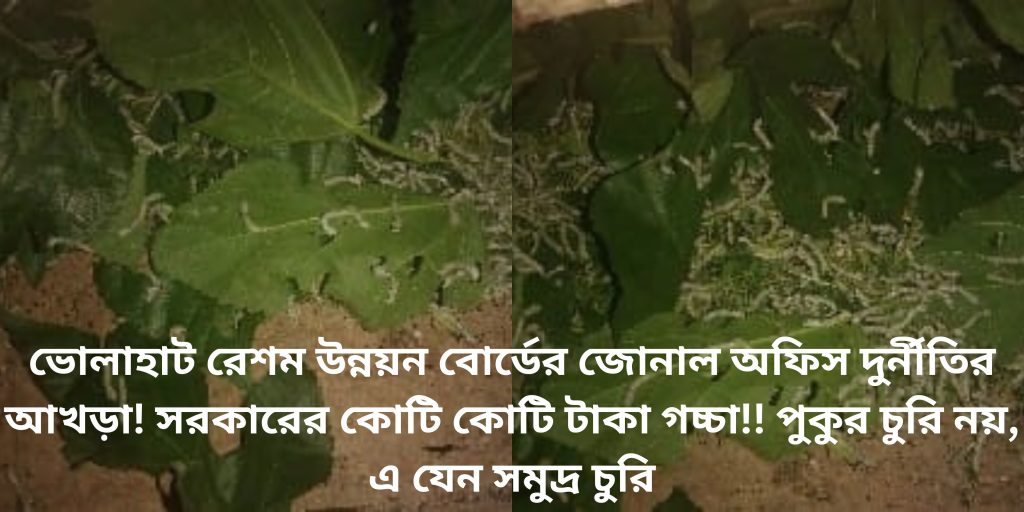
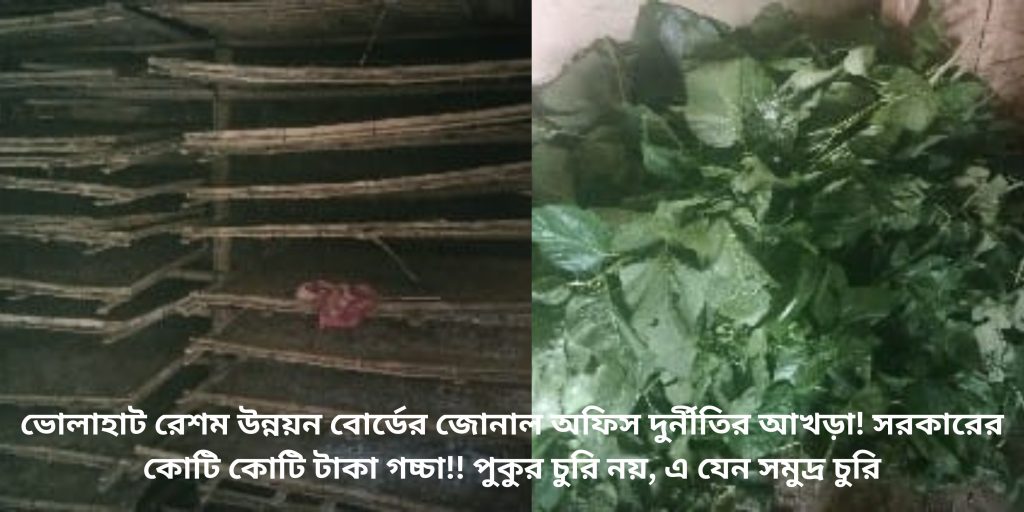
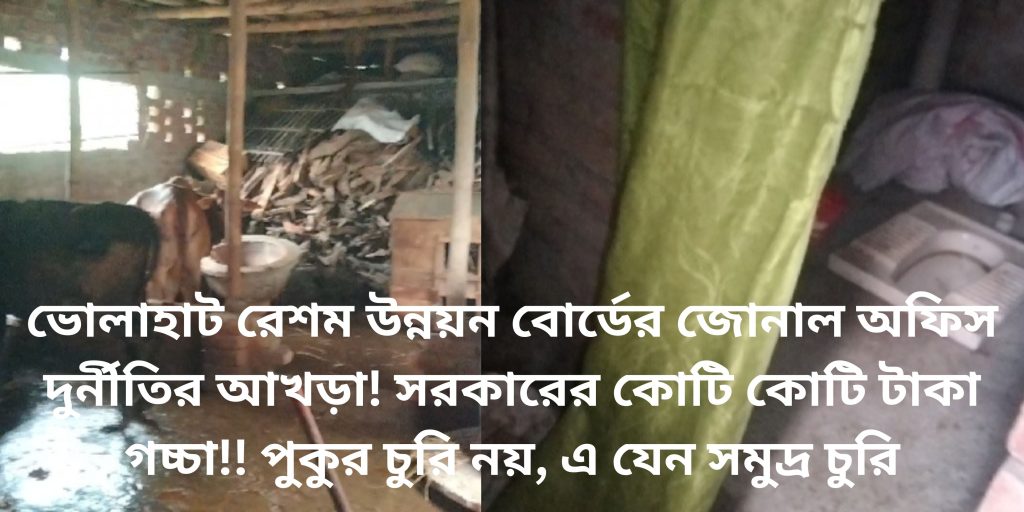
Mulberry leaves are the food of silkworms. According to the rules, Basnis will receive a grant of 25,000 taka for planting mulberry seedlings on 1 bigha of land. But three katha, five katha or seven/ten katha lands are shown as one bigha on paper and the grant of 25,000 taka is embezzled. And against 1 bigha of mulberry land and 1 khop (1 ghara = 16 dala) of silkworm rearing, a Basnis is eligible to receive 1 lakh taka and other materials for building a silkworm house. After receiving all kinds of grants, the beneficiaries throw away the silkworm eggs (seeds) from the silkworm seed bank and bring them home without rearing the silkworms (seric farming). Some women have even built bedrooms and stables with attached bathrooms and barns instead of building a barn with the grant money! This has been witnessed on the ground in Farhana Khatun’s barn code-246 in Gohalbari village.
The government is distributing crores of taka in grants to keep the ancient traditional silk industry alive, but Silk Board Bholahat Zone AD Tariqul Islam, Bangladesh Silk Development Board member (Bosni representative) Md. Samiruddin, temporary employee Monirul Isram and Resham Basni Samity general secretary Md. Sekamuddin Gong syndicate are embezzling government grants through various strategies. As a result, the development of silk is on the verge of destruction. In Dharampur village, there were 14 Basni, now only 4 Basni are left. In Gohalbari village, there were 14 Basni, now 2 are left. It is said that they will also stop silk cultivation. However, all of them have received grants. Many Basni are cultivating sweet pumpkins on mulberry land instead of raising cattle. Samiruddin, member of Silk Development Board (Bosni representative) himself has been seen cultivating sweet pumpkins on mulberry land.
Although every Basni is supposed to be trained, not everyone is being trained! Many are being trained repeatedly in exchange for half the training allowance. The officials snatch that half of the money before the training starts. Even men and women who are not involved in silkworm rearing are being trained under the guise of corruption! However, Abdul Awal of Dharampur village has stopped silkworm rearing due to pride in not getting training. There are many complaints that he did not get training.
Basni complain that germ-free and improved silkworm eggs are not being supplied. Often the silkworms are destroyed and the Basni suffer. The Basni claim that the officials have malicious intentions behind this too. And while improved varieties of “palu” (silkworm or silk moth) are being reared in China and India, the cultivation of old varieties of “palu” remains in our country. Although the Bangladesh Sericulture Development Board has a research laboratory, the Basni are not getting any benefits. As a result, the quality and yield of silkworms are very low.
Md. Jamal Uddin, a silk skein buyer and yarn producer from Jhaubona village, said that the 370 Basni people currently living in Bholahat are taking seeds from the silk seed bank, but not all of them are raising them; they are destroying the seeds by taking them home. Because skeins are not available from everyone. To start a reeling machine or cutting and weaving to make silk yarn, a businessman needs at least 100 maunds of skeins. Then he will somehow survive. He further said that the price of skeins is also low. He claimed that if the Silk Development Board fixes the price of skeins at Tk 30,000 per maund and purchases them, then the Basni Mahal will be able to survive! Silk trader Jamal Uddin also said that the domestic silk industry is suffering due to the lack of a market for silk yarn and silk products. For this, the import of silk yarn and silk products from India, China, Korea, Vietnam, and Tajikistan must be controlled. Due to the lack of a market for domestic silk products, the yarn factories of 450 silk yarn traders in Bholahat have closed down due to business losses. Currently, not enough cocoons are being produced to keep one factory running. If such auspicious evasion continues in the name of development, the condition of silk will deteriorate, Basni Mahal and silk traders fear!
Those concerned say that to save the silk industry, firstly, corruption must be stopped. Secondly, legal action must be taken to return the money from those who have stopped silk farming after enjoying subsidies under silk farming contracts. Thirdly, incentives must be ensured on a priority basis for genuine silk farmers. Fourthly, a high-level impartial and fair investigation into corruption must be conducted. Fifthly, the price of silk cocoons must be determined in a timely manner. Sixthly, eggs or seeds of high-grade silkworms must be provided. Seventh: In order to create a market for domestic silk products, the free import of imported foreign silk products into the country must be controlled. Only then will silk farmers, silk yarn producers, silk cloth manufacturers, weavers and traders see a ray of hope to survive to a large extent. The Bangladesh Silk Development Board and the Textile and Jute Ministry should pay attention to this matter to save the country’s declining agricultural industry!
No information was obtained from Assistant Director Md. Tariqul Islam, who works in 6 districts, after calling on him to find out the overall situation of silk in Bholahat. He is stalling and making excuses! He does not work at the Bholahat Zonal Office. He lives at the head office of the Bangladesh Silk Development Board, Rajshahi. Sometimes he secretly comes to Bholahat on holidays and leaves his workplace quietly after completing his work. Although his mobile phone was contacted several times, no satisfactory response was received!